
You need a roofer. You search “roofing companies Dayton Ohio” and get overwhelmed. Ten options. Different prices. Different claims. Different reviews saying different things.
One company says they’re the cheapest. One says they’re the fastest. One says they’re the best rated. You’re thinking: “How do I even know who’s actually good? What’s the difference between them? Am I going to get ripped off? Am I going to pay too much?”
This is the confusion every homeowner faces. And it’s legitimate confusion. Roofing work is expensive. You’re trusting someone with your home’s protection. You want to make the right choice.
This guide walks you through how to actually evaluate roofing companies in Dayton, what matters and what doesn’t, how to spot the difference between good and mediocre, and how to make a decision you’ll feel confident about.
The Real Problem With Choosing a Roofer
Most homeowners make this decision backwards.
They search. They find five companies. They pick based on:
- Cheapest price
- Fastest callback
- Nicest website
- Best online review they saw
Then they get work done and hope it’s good.
Smart homeowners do it differently. They evaluate based on:
- What actually matters for roofing
- Whether contractor understands your situation
- Whether you trust them
- Whether pricing is fair for quality
Completely different process. Better outcomes.
What Actually Matters When Evaluating Roofing Companies in Dayton
Licensed and insured. Non-negotiable. Don’t even consider unlicensed contractors. Ask to see license and proof of insurance. Don’t take their word. Actually verify.
Local Dayton experience. This matters way more than people think. A roofer from Columbus might not understand Dayton’s specific weather patterns, building codes, and conditions. Local roofers have years of learning what works and what doesn’t here.
How long have they worked in Dayton specifically? Not “in Ohio.” In Dayton. Years matter. Five+ years shows commitment.
Clear communication. Can they explain your roof situation in plain English? Or do they use jargon and avoid direct answers? When you ask a question, do they answer it? Or do they redirect to sales pitch?
Detailed written estimates. Not one-line quotes. Actual itemized breakdown. What materials? How many squares? What prep work? What warranty? If they won’t give you detailed written estimate, walk away.
References and reviews. Google reviews matter. BBB ratings matter. But also ask for references. Call past customers. Ask: Would you hire them again? How was communication? Did they finish on time? Did they clean up? Did warranty work when you needed it?
Reasonable pricing. Not cheapest. Not most expensive. Fair pricing for quality work. If estimate is way lower than others, something’s being cut. If it’s way higher, they’re overcharging.
These are the things that actually predict whether you’ll have good experience.
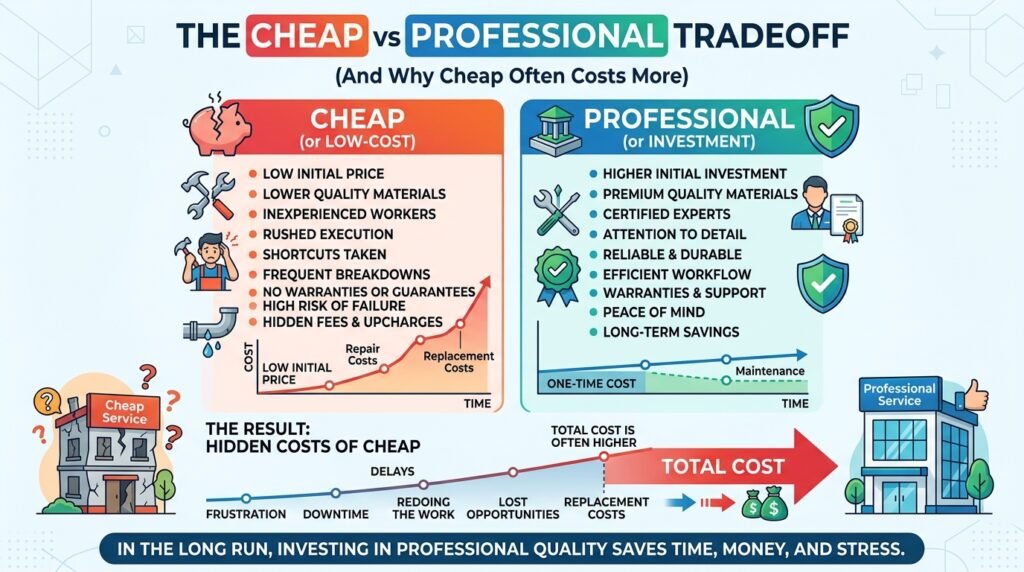
The Cheap vs Professional Tradeoff (And Why Cheap Often Costs More)
“Company A quoted $4,500. Company B quoted $6,200. Why would I pay more?”
Fair question. Here’s why:
Cheap roofer cuts corners: Minimal prep work. Just removes old shingles, puts on new ones. Uses budget materials. Cheaper shingles. Cheaper underlayment. Fewer workers. Takes longer. Rushing increases mistakes. No warranty. If something goes wrong, that’s your problem. Disappears after job. Hard to reach for warranty service.
Result: Roof that lasts 12-15 years instead of 20. More maintenance. Looks less professional. You’re repainting in 10 years instead of 20.
Professional roofer does it right: Thorough prep work. Proper decking inspection. Underlayment properly installed. Quality materials. Good shingles. Good underlayment. Stands up to Dayton weather. Proper crew size. Gets done efficiently without rushing. Clear warranty. Covers materials and workmanship. They stand behind work. Easy to reach. Local. If issue comes up, they respond.
Result: Roof that lasts 20+ years. Holds up to Dayton weather. Looks professional. Minimal maintenance. Peace of mind.
The $1,700 difference over 20 years? It’s saving money to go professional.
Red Flags That Mean Walk Away
“Pay now, we start tomorrow.” Legitimate contractors work on schedule. They don’t demand large upfront payment. They take partial deposit for materials, rest on completion.
Vague about licensing/insurance. “Don’t worry about it.” No. Get proof. In writing.
Pressure to decide today. “This price is only good today.” No it’s not. Good pricing is good pricing. Walk away from pressure tactics.
Not local. Storm chaser from out of state. Here today, gone tomorrow. If issue comes up, good luck reaching them.
No written contract. “We’ll just handshake it.” No. Everything in writing. What’s included? What’s warranty? What’s timeline?
They avoid questions. You ask something, they change subject or get defensive. Good contractors answer directly.
No references. “Just trust us.” Trust is earned. Past customers prove it.
Rough crew. Show up late. Loud. Disrespectful. If they act like this during bidding, imagine during the job.
Too cheap. If it’s significantly lower than everyone else, there’s a reason.
How to Actually Compare Companies Step by Step
Step 1: Start with 3-5 companies. Google search. Ask neighbors. Ask friends. Get a list.
Step 2: Verify credentials. Call each. Ask for license number. Ask for insurance proof. Don’t continue with anyone who won’t provide this.
Step 3: Request written estimate. Not a phone quote. Written. Itemized. Details matter.
Step 4: Read reviews. Google, BBB, Facebook. Look for patterns. One bad review happens. Five bad reviews is a pattern.
Step 5: Call references. At least one per contractor. Ask specific questions. Would you hire again?
Step 6: Check local experience. How long in Dayton? Have they worked on homes like yours?
Step 7: Compare apples to apples. Make sure estimates are for same scope. Same materials. Same prep. Then compare.
Step 8: Trust your gut. After all this, which contractor did you feel most confident with? Which one answered questions? Which one felt trustworthy?
Step 9: Make decision. Choose the one with best combination of local experience, clear communication, fair pricing, and good reviews.
The Local Advantage: Why Dayton-Based Matters
A roofer working in Dayton for 10 years understands:
Weather patterns. What materials hold up to freeze-thaw cycles. What doesn’t. They’ve seen failures and learned.
Building codes. Local permit requirements. Inspection standards. They do work that passes inspection first time.
Material sourcing. Know local suppliers. Can get quality materials fast. Don’t have to order from out of state.
Storm damage patterns. Know how hail hits roofs here. Know wind patterns. Know what to look for in damage assessment.
Warranty service. Local means they’re here if you need them in five years. Not a voice on phone from out of state.
Reputation. They live here. Care about reputation. You can find them if needed.
This local knowledge prevents costly mistakes.
Questions to Ask Every Contractor
About experience: “How long have you worked in Dayton specifically?” (Not Ohio. Dayton.) “Can you show me examples of recent work on homes like mine?”
About the work: “What’s your prep process? Walk me through it.” “What materials do you recommend and why?” “What warranty do you offer?”
About the project: “What’s your timeline?” “What happens if you find structural damage during work?” “How do you handle unexpected issues?”
About communication: “How will you keep me updated?” “Who will I contact if I have questions during work?” “How is warranty handled if I need service later?”
Good contractors answer confidently. They don’t get defensive. They explain clearly.
Making Your Final Decision
After all this, you’ve got maybe 2-3 contractors who passed the evaluation.
Pick the one where:
- You feel confident in their experience
- Communication was clear and responsive
- Pricing is fair (not cheapest, not most expensive)
- References were positive
- You trust them
That’s your contractor.
Don’t overthink it. You’ve done the evaluation. Now make the decision and move forward.
Frequently Asked Questions
How do I verify a roofing contractor is actually licensed?
Ask for their license number. Then call the Ohio Contractors Board and verify the license is active and in good standing. Takes five minutes.
What should a roofing estimate include?
Itemized details: materials (brand and quantity), labor cost, prep work, any structural repairs, warranty details, timeline, and total price.
Is the cheapest estimate always a bad choice?
Not always, but usually. Very cheap often means corners are being cut. Fair pricing for quality work is the goal.
How important is warranty?
Very. Warranty proves contractor stands behind work. Get warranty in writing. Understand what’s covered and for how long.
Should I hire local or can I use national company?
Local is better for follow-up service and understanding Dayton conditions. National companies may be less responsive to local issues.
How many estimates should I get before choosing?
Three is ideal. Gives you range of pricing and options. Helps you see what’s reasonable.
What should I do if I find problems after work is done?
Contact contractor immediately. Show them photos. Warranty should cover legitimate issues. Document everything.
Bottom line: Choosing a roofing company in Dayton doesn’t have to be overwhelming. Verify licensing. Get written estimates. Check local experience. Read reviews. Call references. Choose the contractor with best combination of experience, communication, and fair pricing. Trust your evaluation process. You’ll make a good choice.