
Where do most roof leaks come from?
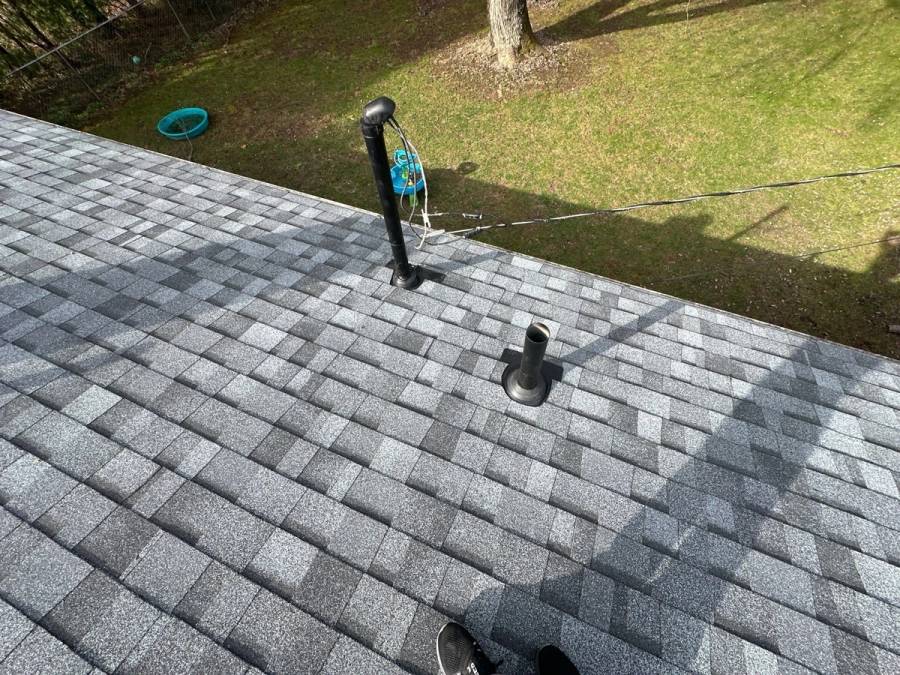
A roof leak almost always gets blamed on the shingles. In the leaks we investigate, the cause usually turns out to be a penetration or a flashing detail rather than a failure across the shingle field.
Asphalt shingles installed correctly shed water reliably for a long time. What fails first, far more often, is a detail. A rubber boot around a plumbing vent cracked from years of UV. Step flashing along a chimney that has come loose or was never sealed correctly in the first place. The flashing around a skylight curb.
The reason is simple once you think about it. A field of shingles is a continuous, uninterrupted system doing one job. A penetration is a place where that system has to be interrupted and then sealed back up around something that's not a shingle. A pipe, a chimney, a vent, a skylight.
Every interruption is a place where water has an alternative path if the detail isn't right. And every one of those details is a separate decision made by whoever installed it, with its own failure mode and its own lifespan. Rubber boots in particular tend to crack and fail well before the shingles around them are due for replacement.
When the leak is out in the field
Occasionally a leak does show up in the middle of a roof plane, away from any penetration. When it does, the underlayment is usually the reason.
Manufacturers ask for a four inch overlap between courses, and six inches where one roll ends and the next begins. That overlap is what stops wind driven rain from tracking back up under the shingles and finding its way to the deck. If the overlap is short, water has a path.
Fasteners matter here too, and this is one most homeowners never hear about. Cap nails are shaped like a small umbrella. Installed correctly, the cap sits flush to the deck and the nail is driven home securely, so the cap seals against the underlayment. Water that gets under the shingles runs around the fastener instead of down the shank. Installed carelessly, driven at an angle or left proud, that same fastener becomes a hole.
How we build it
We put down two layers of synthetic underlayment. It comes on a four foot roll and we overlap twenty four inches everywhere, courses and end laps alike. Every course covers half the one below it, which means every square foot of that deck carries two layers rather than one.
It's not a marketing term for doing it the normal way.
At penetrations, we run the underlayment up to the detail as specified, then add a separate piece of ice and water shield over it to encapsulate every seam that comes together there and reseal around the protrusion itself.
Those are two different measurements. Ohio's two inch figure is a single layer lap on a normal slope, and its nineteen inch figure applies where two layers are required on a low slope. We apply the two layer approach everywhere, at twenty four inches.
There are a lot of fasteners in that area. Adding a little more material before the shingles go on is inexpensive compared to the shingles themselves, and it's what keeps water out at the point most likely to let it in.
Code and manufacturer minimums are the floor. Building past them in the places most likely to fail is a large part of why we can stand behind our work the way we do.
What this means when you have a leak
A leak inspection has to treat penetrations as their own category, not as part of a general look at the roof. Finding the specific failed detail is usually the difference between a straightforward conversation and an unnecessary one about replacing the whole roof.
Where we do find a penetration causing a problem, we do not patch it. We rebuild the affected elevation to The Helping Hands Roofing Standard, so that elevation sheds water at the detail rather than relying on sealant to hold it back. That work carries our Lifetime Workmanship Warranty.
Fixing a leak should mean it's fixed.