
Do I need gutters on my house?
Yes. A roof sheds a lot of water, and it has to go somewhere. Gutters collect it along the edge of the roof, and downspouts carry it down and out away from the house. Without them, every rain sends water straight off the roof edge onto the ground along your foundation, in the same spot, storm after storm. The rainfall figure comes from the National Weather Service's Dayton climate normals (opens in a new tab), and the gallons figure from the U.S. Geological Survey (opens in a new tab).
What happens to a house without gutters?
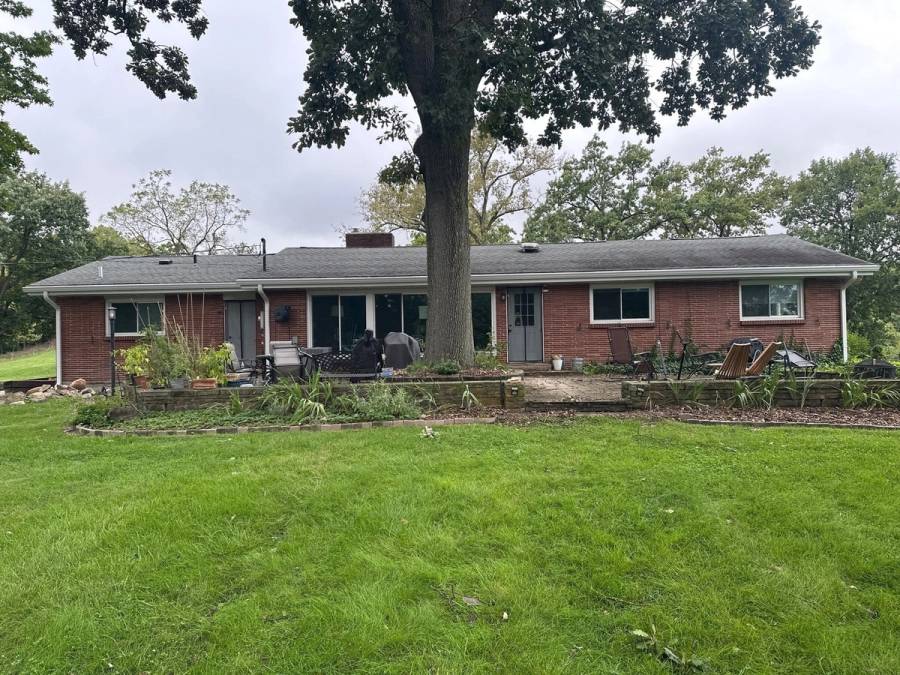
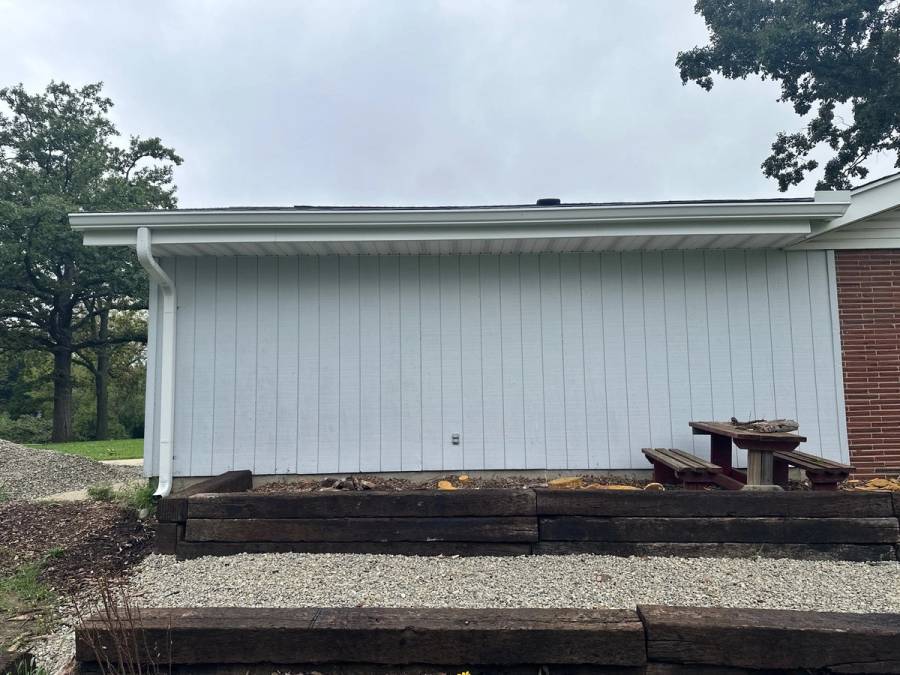
Here's what we usually find on Dayton-area homes that don't have them:
- Wet basements. Water soaks into the soil right against the foundation.
- Washed-out flower beds. Water falling from the roof edge digs the mulch and soil out of the beds below.
- Ice in the winter. Water that lands on walks, steps and the driveway freezes into slick patches.
Gutters and downspouts prevent all three, because the water never lands in those spots to begin with.
Are gutters required by code in Ohio?
Only in certain conditions. Section 801.3 of the Residential Code of Ohio (opens in a new tab) says: "In areas where expansive soils or collapsible soils are known to exist, all dwellings shall have a controlled method of water disposal from roofs that will collect and discharge roof drainage to the ground surface not less than 5 feet (1524 mm) from foundation walls or to an approved drainage system." In plain terms, code requires roof drainage where the soil is known to swell or settle with water, and doesn't require it anywhere else. Your local building department can tell you whether that applies to your lot. Either way, code is the minimum. It isn't a promise that your basement stays dry.
Why do some new homes not have gutters?
Because Ohio's code doesn't require them unless the soil calls for it, a builder can hand over a new house without gutters. That's a decision about the legal minimum, not about what's good for the house. The roof sheds just as much water either way, and the problems above show up just the same.
How do you handle roof runoff without gutters?
People ask us about rain diverters, rain chains, splash blocks and buried drain lines. Each of these deals with the water at a single spot, or after it's already on the ground. None of them collects the water along the full length of the roof edge and moves it away from the foundation, and that's the job gutters and downspouts do. We don't install underground drainage, and we don't recommend leaving gutters off any part of a house.
Does a drip edge replace gutters?
No. Drip edge is the metal flashing along the edge of the roof that protects the edge of the roof deck. It keeps water off the wood, but it doesn't carry water anywhere. On every roof we install, we put gutter apron along the eaves and drip edge along the rakes, and the gutters take the water from there.
Can skipping gutters affect my roof warranty?
It can. Owens Corning's limited warranty (opens in a new tab) lists what it won't cover, and one item is "Damage caused by improper or inadequate roof ventilation or roof drainage." Gutters are a big part of how a roof drains.
Where should the downspouts let the water out?
Away from the foundation. Where Ohio's code requires roof drainage, it calls for the water to come out at least 5 feet from the foundation walls, or into an approved drainage system.
How much do gutters cost?
Our seamless gutter installation page lists our published Dayton price per foot, explains what changes it, and has an online calculator.
Jobs behind this article
-
 261 Feet of 6-Inch Gutters on South Elm St, West Carrollton
-
 Overflowing Porch Gutter Fixed on Blocker Dr, Kettering
-
 Tree Through the Roof on Stauffer Dr, Beavercreek
-
 Weathered Roof and New Gutters on Bassett Ct, Beavercreek
-
 Gutter Pulling Off the House Replaced on Arkansas Dr, Xenia
-
 Roof, 6-Inch Gutters and Guards on Fergus Dr, Beavercreek
Our drone photos are taken by FAA Part 107 certified drone pilots.
Next step
Next step: see what goes into a seamless gutter installation, with our Dayton prices. Or book a free roof inspection, and we'll look at your gutters and downspouts along with the roof.
