
How long does an asphalt shingle roof last?
We tell homeowners that a properly installed asphalt shingle roof lasts 20 to 40 years. That's a twenty year spread, and most of it comes down to how the roof was put on and what the attic under it is doing.
How long do 3-tab and architectural shingles last?
InterNACHI (opens in a new tab) puts architectural asphalt shingles at about 30 years and 3-tab shingles at about 20. Owens Corning's roofing glossary (opens in a new tab) describes architectural shingles as "Shingles containing more than one layer to create extra thickness." 3-tab shingles are strip shingles, which it describes as "Asphalt shingles made from a single layer." Every roof we install uses Owens Corning Duration architectural shingles. Those figures are guidelines, not guarantees. How the roof was installed, how the attic breathes and what storms it sees determine the lifespan of your roofing system.
Is a 20-year-old roof too old?
Not by age alone. A 20-year-old 3-tab roof is at the end of its expected life. A 20-year-old architectural roof may have years left. What decides it is condition: the signs below, and what we find on the roof. If storm damage is part of the picture, here's whether insurance will pay for a 20-year-old roof.
What shortens the life of a roof in Ohio?
Heat held in the attic. A hot attic dries shingles out from underneath. The sealant strips let go first, then the shingles turn brittle and shed the granules that shield the asphalt from the sun. Ohio sets a minimum for attic ventilation, and how attic ventilation works covers the numbers.
Ice at the eaves. Ohio winters build ice along the bottom edge of a roof, and water backs up behind it. That is why Ohio requires an ice barrier from the roof edge to at least 24 inches inside the exterior wall line.
Details that wear out before the shingles do. The rubber boot around a plumbing vent cracks from years of sun, well before the shingles around it are due. A leak at a pipe or a chimney means one detail failed. It doesn't mean the roof is finished.
Storms. Wind and hail can end a roof early at any age. Hail big enough to do it isn't common around Dayton, but it happens. Small, pea size hail doesn't really damage shingles. What storm damage looks like is worth knowing before you call your insurance company.
What are the signs you need a new roof?
Three things to watch for.
- Granules collecting in the gutters or at the bottom of the downspouts
- Shingles that lift or crease in the wind because the seals have let go
- Shingles that have gone brittle and shed granules where they bend
Any one of these is a reason to have the roof looked at. A single sign doesn't mean the roof has to be replaced.
On Bassett Ct in Beavercreek, the old roof showed weathered shingles and an earlier repair before we replaced it.
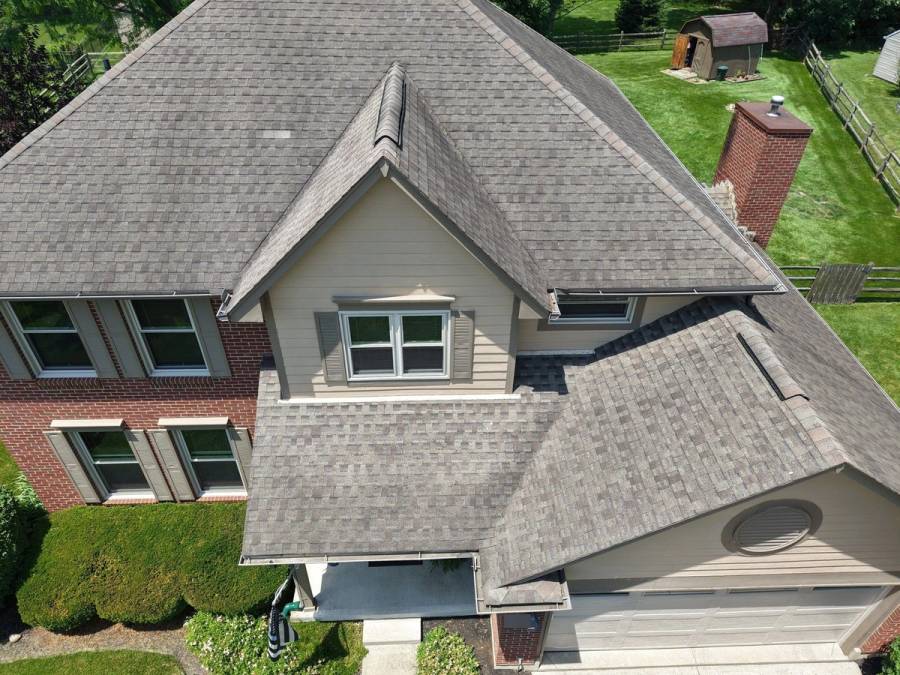
Our drone photos are taken by FAA Part 107 certified drone pilots.
How we build a roof to last
Every roof we replace is a full tear-off down to the deck. We walk the deck, photograph it clean, and replace any soft or rotted decking. Ice and water shield goes on in two rows at the eaves, one row in every valley, along every roof-to-wall transition and around everything that comes through the roof. Two layers of synthetic underlayment go over the whole deck, overlapped 24 inches.
On top of that goes a complete Owens Corning Duration system: Owens Corning starter strip, Duration shingles, and Owens Corning hip and ridge caps, installed to the manufacturer's specifications. The layers of a roof explains what each one is there to do. Our roof replacements carry the Lifetime Workmanship Warranty.
On Forest Oaks Dr in Beavercreek, we built the roof this way in October 2026.
How often should a roof be inspected?
Every five years, and any time you notice something out of place. A free roof inspection takes about 30 minutes for most homes. We start on the ground, go up on the roof, photograph every finding and explain it in plain words.
Jobs behind this article


Our drone photos are taken by FAA Part 107 certified drone pilots.